The STEP Standard - ISO 10303
STEP for CNC Machining
The STEP-NC AP238 standard is the result of an international effort, begun in the late 1990s, to replace the RS274D (ISO 6983) M and G code standard with a modern associative language that connects the CAD design data used to determine the machining requirements for an operation with the CAM process data that solves those requirements. STEP-NC builds on the previous ten year effort to develop STEP data standards for CAD data and uses the modern geometric constructs in STEP to define device independent tool paths, and CAM independent volume removal features.
You can find more information about the development and deployment on the STEP-NC Standard Page
Background
STEP-NC defines a CNC part program as a series of operations that remove material defined by features. The features supported include holes, slots, pockets and volumes defined by 3D surfaces. Each operation contributes to the manufacture of a feature by defining the volume of material to be removed, the tolerances, the type of tool required and some basic characteristics such as whether this is a roughing or finishing operation. The operations are then sequenced into a work plan that converts the stock into the final part. The work plan may be sophisticated and include conditional operations that depend on the results of probing operations, and it may be divided into sub-plans to be executed concurrently on machines that have multiple cutting heads.
A key feature of STEP-NC AP238 programs is that they are machine and organization independent. If a machine has the underlying capabilities (axes, table size etc), then a STEP-NC "compiler" should be able convert the part program into a sequence of tool movements for that machine. If a CNC has a Tool Cutter Programming (TCP) interface then the tool movements can be executed directly without converting to axis movements. This has two significant consequences for industry.
- If parts can always be rapidly manufactured from an AP238 description, then there is no longer a requirement to keep copies of those parts in the inventory. A recent study for the UK Navy estimates that at least $4M can be saved for one depot (and up to $640M can be saved for the entire UK Navy) if the depot can store its spare parts as electronic product data instead of as physical items.
- If parts can be made independently of the axis codes, then the same CNC program can be run on many machines. This allows a part program to be made once and run anywhere. Another study has shown that a mid sized machine shop could save as much as $0.5M per year in reduced CAM costs, less waste, and greater throughput if it received reliable machine independent CNC data from its customers.
Fig. 3 shows how design data is communicated to manufacturing in current practice. Design creates the specification for a product as a 3D model. Detailing decides the manufacturing requirements for the product by making a drawing. Path planning generates tools paths. Manufacturing controls production. The job of design is performed using a CAD (Computer Aided Design) system, the job of detailing is performed using a drawing CADD (Computer Aided Design Draughting) system, the job of path planning is performed using a CAM (Computer Aided Manufacturing) system, and job of manufacturing is controlled using a CNC system. In many cases the CAD, CADD and CAM functions are combined into a single integrated CAD/CAM system but in all cases the CNC function is performed by a separate system.
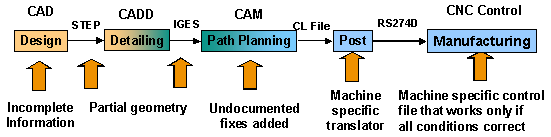
Information can be lost in the pipeline because incomplete data is sent from the CAD to the CAM, because fixes to the geometry are made in the CAM and not communicated back to the CAD, because only the surface data is communicated to the post, and most of all, because the RS274D standard only allows axis movement data to be communicated to the control. This means that no adjustments can be made on the control in response to changes in the available tooling, the control cannot optimize the machining process for the capabilities of the selected machine, and the operator cannot rely on software in the control to check the safety of the set-up and the program.
In the new method enterprises can continue to use their existing systems for CAD, CADD and CAM, but the end result is sent to the CNC as a STEP-NC AP238 file instead of an RS274D file. Fig. 4 shows the modified pipeline. The change is small because no systems need to change only the interfaces, but the advantages are significant:
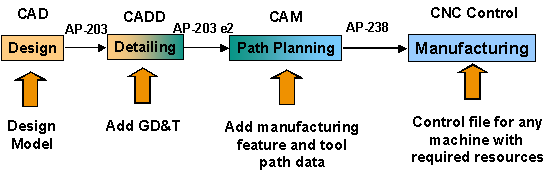
- The AP238 file can make developing a CNC part program more efficient because the programmer only has to describe the tasks to be performed on the machine and not the tool motions necessary to achieve those tasks.
- The AP238 file allows a CNC to optimize and check a part program for the tooling available at the time of manufacturing instead of having it fixed at the time of planning.
- The AP238 file reduces the requirement for drawings on the shop floor and it allows manufacturing to send requests for changes back to design by annotating the original full fidelity design information.
- The AP238 file makes manufacturing data portable between machines and organizations and allows a part to be made on any machine with sufficient resources (axes, table size etc).
The deployment of AP238 may take a different path to that of AP203 because the economic benefits are quite significant. There has been considerable early testing of AP238 by industry as a new interface for defining machine independent tool paths. This is the concept originally defined for BCL (RS494). However, BCL did not have a means to display the design geometry and tolerances of the part, or the features being manufactured in each operation. There is strong reason to believe that if this data is added then AP238 CNC machine independent files can be used as the basis for contracting work between customers and suppliers and if this is so then the deployment of AP238 may be driven by stronger economic forces than those that lead to the implementation of AP203.
NEXT: Future of STEP
[3] ISO 14649-1:2001 Industrial automation systems and integration Physical Device Control-Part 1: Overview and Fundamental Principles, Draft International Standard ISO TC184/SC4, 2001.
[4] Suh, S.H., Cho, J.H., and Hong, H.D., 2001, "On the architecture of intelligent STEP-compliant CNC," Int'l J. Computer Integrated Manufacturing, Vol. 15, No. 2, January 2002, pp. 168-177